The Physics of Flexible Concrete Repair: Why Routing Outperforms Filling
Most property owners treat concrete cracks as a cosmetic nuisance, applying a bead of caulk as if they were sealing a window frame. In reality, a crack is a newly formed expansion joint that the slab "chose" to create to relieve internal stress. When a filler is smeared over a hairline fracture, the next thermal cycle usually tears the patch away because there is insufficient material volume to absorb the movement.
This guide details the engineering behind concrete crack routing and sealing, moving beyond aesthetic "band-aids" toward structural remediation. For homeowners managing aging driveways or pool decks, understanding the mechanical bond between sealant and substrate is the difference between a durable repair and a seasonal headache. Evidence suggests that non-routed crack filling on average lasts 5 years, according to pavemade.com.
Why Surface-Level Crack Fillers Consistently Fail
Standard fillers fail not because of the chemical composition of the product, but because of the physics of the gap. When a crack is too narrow, the sealant has nowhere to go when the slab shifts.
- Thin layers of sealant lack the mass required to stretch, leading to cohesive failure where the material rips down the center.
- Direct-to-crack applications often trap air pockets at the base, which expand in the heat and blow the patch out of the surface.
- Rough, jagged edges on unrouted cracks prevent the sealant from forming a uniform "hourglass" shape, which is essential for even stress distribution.
- Vertical movement between two sides of a crack—often caused by expansive clay soils—will shear a surface-level patch instantly.
The Operational Framework for Structural Crack Sealing
1Execute the Mechanical Route
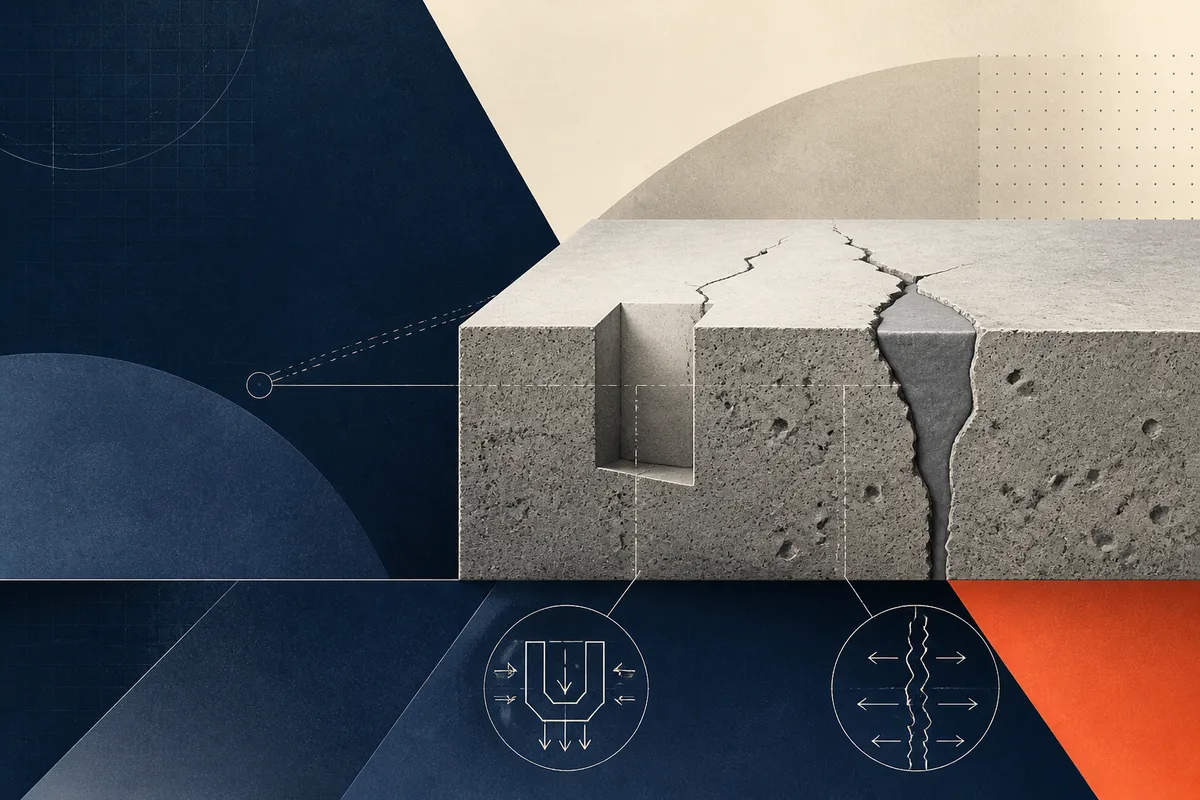
Chasing the crack involves using a diamond-bladed router or a small grinder to widen the fracture into a "V" or "U" shaped channel. According to txdot.gov, routing and sealing is an effective method to prevent water infiltration by creating a defined reservoir for the repair material. This reservoir should generally be wider than it is deep to allow for maximum flexibility.
2Standardize the Reservoir Geometry
The goal is to achieve a specific width-to-depth ratio, often 2:1 or 1:1, depending on the sealant type. By creating a wider opening, the sealant can undergo "internal de-bonding" or stretching without pulling away from the concrete walls. This geometry ensures that the material acts like a rubber band rather than a rigid plug.
3Clear the Bond Breaker
The bond between the sealant and the concrete is compromised by any leftover dust, laitance, or old organic growth. High-pressure air or wire brushing is required after routing to expose the "bright" concrete. Without this step, the sealant adheres to the dust rather than the slab, leading to premature delamination.
4Install Backer Material
In deep cracks, a foam backer rod is inserted into the routed channel before the sealant is poured. This prevents "three-sided adhesion," where the sealant sticks to the bottom of the crack as well as the sides. If the material is anchored at the bottom, it cannot stretch horizontally, which leads to immediate tearing during the first cold snap.
The Role of Water Intrusion in Slab Displacement
Effective crack treatment is less about the surface appearance and more about protecting the subgrade. According to ameripavement.com, crack repair is a vital step in protecting the pavement surface from water penetration.
When water enters an unsealed crack, it softens the soil beneath the slab. In the Sacramento area, where soil can vary from heavy clay to sandy loam, this moisture causes localized "pumping" or settling. Over time, the unsupported section of the concrete will snap under the weight of a vehicle. Routing the crack ensures the sealant has enough "bite" to stay in place, effectively waterproofing the joint and extending the life of the surrounding driveway resurfacing work.
The ratio of the width of the sealant to its depth; a critical metric that determines the percentage of elongation a joint can handle before failing.
How Sacramento Concrete Resurfacing helps
Remediating structural cracks requires an assessment of whether the crack is "active" (moving) or "dormant" (settled). A standard scope of work for a property in the Elk Grove service area should include mechanical routing of all visible fractures, deep-cleansing of the voids, and the application of an industrial-grade polyurea or epoxy-based sealant. Homeowners should prepare by clearing the area of vehicles and identifying any areas where the slab has already begun to "trip" or settle unevenly. A professional remediation plan focuses on stabilizing the slab to prevent further propagation before any decorative overlays are applied.
Frequently asked questions
Is routing a crack better than using an epoxy injection?
Routing is preferred for cracks subject to thermal movement or "breathing," as it allows for a flexible seal. Epoxy injection is a structural "weld" intended for dormant cracks where the goal is to restore the monolithic integrity of the slab. If a moving crack is injected with rigid epoxy, a new crack will typically form near the repair.
How long should I wait to seal a new crack in a Sacramento driveway?
Wait until the slab has gone through at least one full seasonal cycle (summer to winter). This allows the concrete to reach its maximum shrinkage point. Sealing too early may result in the crack continuing to widen beyond the sealant's elongation capability, requiring a second round of routing.
Can I skip routing if the crack is already wide enough?
Even if a crack appears wide, the interior walls are often contaminated with dirt, oil, and loose concrete. Routing is still necessary to provide a clean, squared-off shoulder for the sealant to grip. Without a fresh mechanical edge, the bond strength is significantly reduced.
Will the routed crack be visible under a new coating?
If the goal is a seamless finish, the routed and sealed crack is typically covered with a reinforced mesh or a specialized base coat during the resurfacing process. This "bridges" the joint, allowing the slab to move underneath while the decorative topcoat remains intact.
How does the heat in Sacramento affect the choice of sealant?
In high-temperature environments, sealants must have a high "shore hardness" to prevent tracking while remaining flexible. Professional-grade materials are engineered to stay stable at temperatures exceeding 100 degrees Fahrenheit without becoming brittle when the temperature drops in the winter.
What happens when you get in touch: you describe the situation, we ask the few questions that actually change the answer, and you get a clear scope and next step — no obligation.