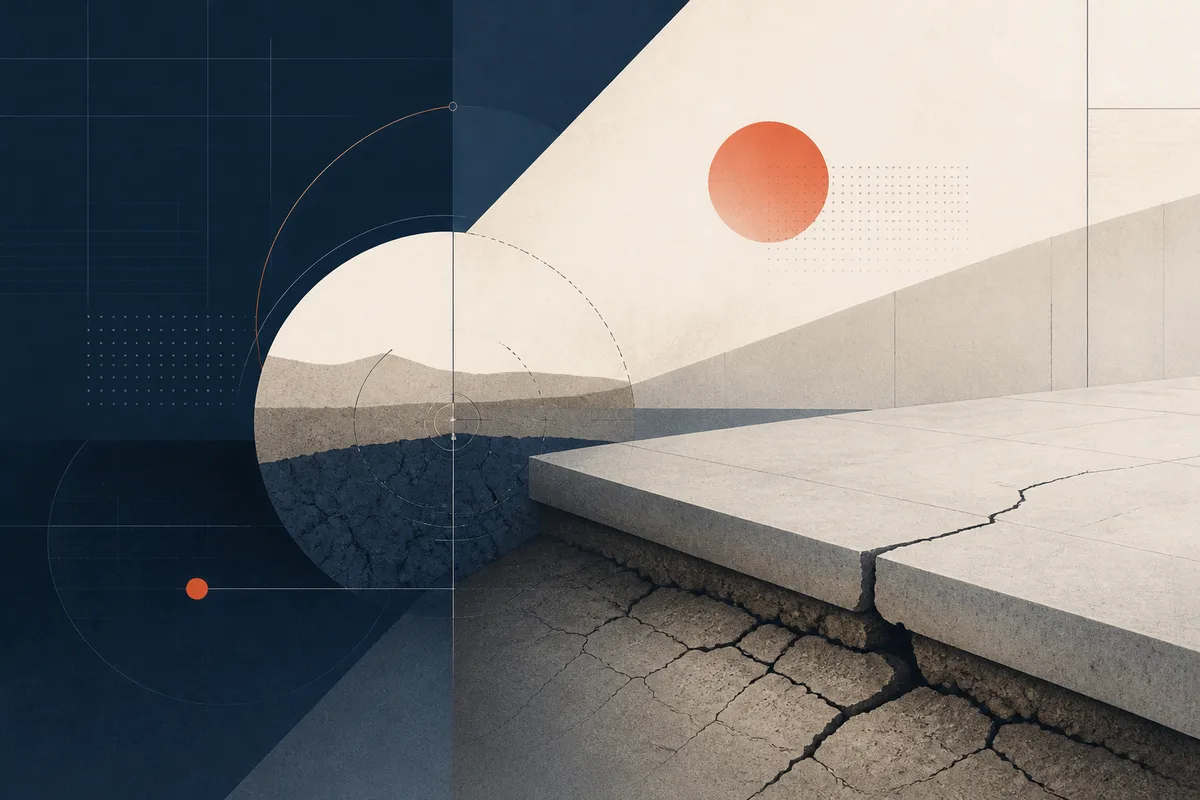
The Valley Clay Effect: Why Sacramento Driveways Succumb to Expansion
Homeowners across the Central Valley often mistake slab cracking for poor pouring technique or thin concrete. In reality, the failure usually begins several inches below the surface within the region's dense, expansive clay. When this soil absorbs water during wetter seasons, it swells with enough force to lift heavy masonry; as it dries during parched months, the soil shrinks, leaving the slab unsupported and prone to snapping under its own weight.
This guide breaks down the mechanics of the "Valley Clay Effect" and provides a framework for evaluating soil-induced damage. It is intended for property owners who need to differentiate between superficial cosmetic wear and structural failures caused by subgrade movement.
The Mechanics of Soil-Driven Concrete Failure
Slab failure in this region is rarely a single event but rather a result of cyclic stress. The California Geological Survey monitors seismic and geological conditions, but for the average homeowner, the most immediate threat is the Official Series Description of Sacramento soils, which are characterized by poor drainage and alluvium deposits.
- Swelling pressure from hydrated clay particles creates upward "heave" that exceeds the tensile strength of the concrete.
- Soil shrinkage during drought cycles creates subterranean voids, leading to settlement cracks when vehicles traverse the unsupported sections.
- High clay content—ranging from 35% to 60% in the argillic horizon of Redding series soils—prevents rapid drainage, keeping the slab in contact with moisture for extended periods.
- Chemical leaching occurs when acidic soil reacts with the lime in cement, potentially softening the material from the bottom up.
The Playbook for Stabilizing Impacted Slabs
1Identify the crack morphology
Not all cracks are created equal; vertical displacement, where one side of the crack is higher than the other, indicates active soil heaving. Hairline fractures may be shrinkage-related, but wide, jagged gaps typically signal that the subgrade has shifted significantly.
2Address the moisture gradient
To slow soil movement, the moisture levels around the slab must be stabilized through proper grading and gutter redirects. Consistent moisture is often better for clay stability than extreme cycles of saturation and dehydration, which accelerate expansive soils failures.
3Evaluate soil chemistry
Before committing to a high-end overlay, property owners should consider the corrosion potential of their specific lot. According to a geotechnical investigation, soil with a pH of 5.5 or lower is considered corrosive and can react with the lime in cement to cause leaching.
4Select a compatible repair method
Rigid patches often fail in areas with active soil because they cannot move with the clay; instead, the slab simply cracks again next to the repair. Utilizing a professional concrete crack repair and sealing approach involves cleaning the voids and using materials designed to maintain a bond during thermal and soil expansion.
The Chemistry of Concrete Corrosion
While physical movement is the primary culprit, chemical degradation plays a silent supporting role. In certain parts of the valley, sulfates in the soil react with the lime in the cement paste. This reaction causes the concrete to soften and crack over time, a process that is exacerbated in poorly drained "basin floor" environments.
The weighted average of clay particles in the upper 20 inches of subsoil, which dictates the total expansion potential of the site.
When the clay content is high, the soil acts like a sponge. Soils that display cyclic heaving and shrinkage will ultimately cause slab and wall cracking as the subgrade moves according to Penn State College of Engineering research. This is why a simple "fill and paint" job rarely lasts more than one season in Northern California.
How Sacramento Concrete Resurfacing helps
Managing expansive soil requires a scope of work that accounts for local geomorphology. A standard project involves assessing the current slab for structural integrity, grinding down heaved edges to restore a level profile, and applying professional-grade overlays designed for environmental durability. For those in nearby areas like Folsom or seeking Elk Grove service area expertise, the focus remains on isolating existing cracks so they do not telegraph through the new surface. A sound scope of work for driveway resurfacing should always include mechanical cleaning of joints and the use of polymer-modified products designed for the regional climate.
Frequently asked questions
Why do my cracks get wider in the summer?
During dry summer months, moisture evaporates from the clay soil, causing it to lose volume and shrink. This removes the foundational support from beneath the concrete, allowing the slab to settle into the new gaps, which pulls existing cracks further apart.
Can I just pour new concrete over the old cracked slab?
Pouring a thin layer of standard concrete over an existing cracked slab is rarely successful because of "reflective cracking." As the clay soil moves the original base slab, those movements will be forced directly through the new layer; a polymer-modified overlay or a specialized resurfacing product is usually required to bridge these movements.
Does the pH of my soil really matter for my driveway?
Yes, because soil with a pH of 5.5 or lower can be corrosive to concrete, according to Caltrans Corrosion Guidelines. This acidity can leach the lime out of the concrete, weakening the slab's internal structure and making it more susceptible to cracking under the pressure of expansive clay.
How does drainage impact my concrete cracks?
Poor drainage allows water to pool near the edges of the slab, which saturates the clay and causes localized heaving. By ensuring water moves away from the concrete, you reduce the "cyclic heaving" that leads to the most severe structural cracks seen in Valley homes.
Is crack sealing enough to stop the damage?
Sealing is a vital maintenance step that prevents water from reaching the subgrade through the cracks, which limits further soil expansion. However, sealing alone does not fix the underlying soil instability; it is a defensive measure to prolong the life of the slab after it has already been damaged.
What is the Redding soil series and why is it mentioned?
The Redding series consists of soils with a reddish-brown clay subsoil and a gravelly claypan. Because these soils have high clay content (35% to 60%), they are particularly prone to the expansion and contraction cycles that cause driveway and patio failure.
What happens when you get in touch: the situation is described, specialists ask the few questions that actually change the answer, and a clear scope and next step is provided — no obligation.