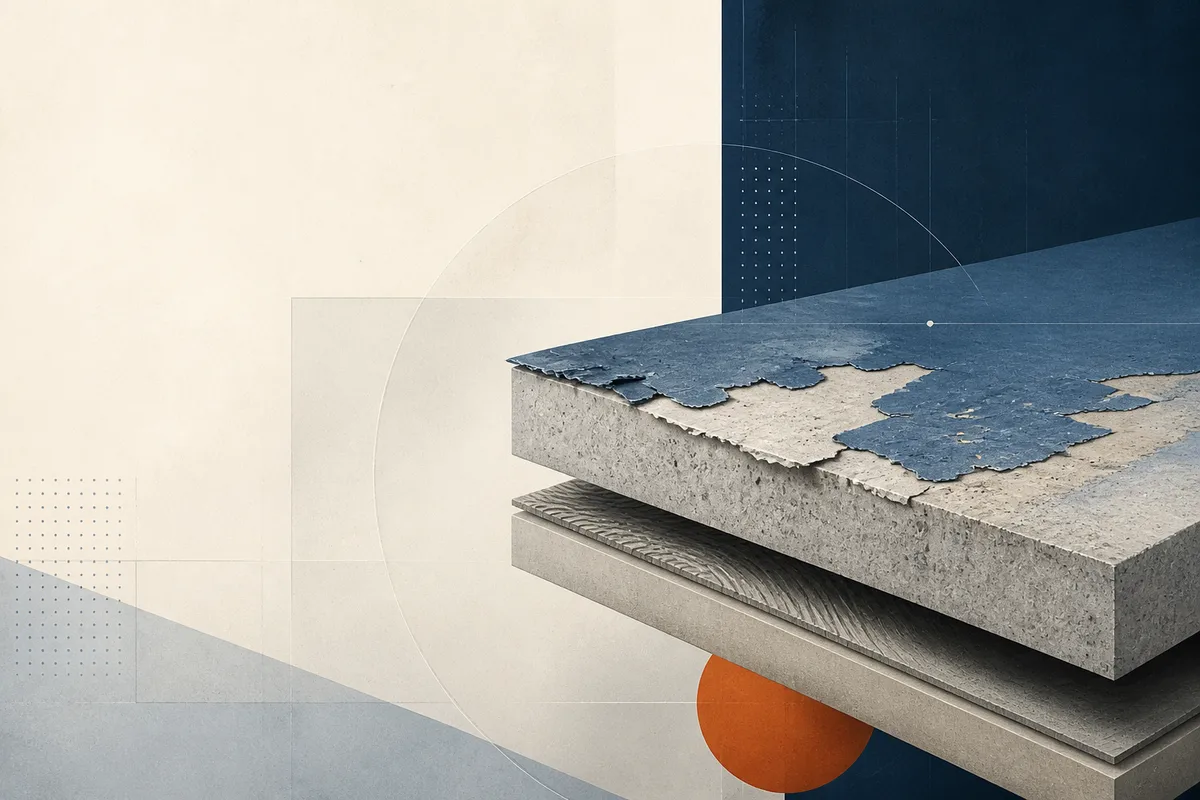
Why Exterior Slabs Shed Paint and How Cementitious Overlays Solve the Bond Problem
Homeowners often view concrete paint as a cost-effective weekend project to hide oil stains or spiderweb cracks. In reality, applying a film-forming coating to an exterior slab is usually a countdown to failure. The combination of hydrostatic pressure from the soil and intense sun creates an environment where non-breathable paints bubble and peel, leaving the driveway in worse condition than the original bare concrete.
Choosing between a concrete overlay vs paint requires an understanding of how materials interact with a porous substrate. While paint acts as a thin plastic skin, a cementitious overlay is a structural resurfacing agent designed to become part of the slab itself. This article breaks down the mechanical failures of topical coatings and provides a framework for selecting a durable, long-term solution for aging concrete.
Why topical coatings fail on high-traffic concrete
Paint and low-grade epoxies fail on driveways because they lack the breathability and elasticity required for exterior environments. When moisture migrates through the slab from the ground—a process known as capillary action—it hits the underside of the paint film and builds pressure until the bond snaps.
- Hot tire pick-up occurs when heat from vehicle tires softens the paint film, causing it to peel away as the rubber cools and contracts.
- UV radiation breaks down the chemical resins in standard paints, leading to chalking and color fading over time; concrete paint fails predictably within 3-5 years, peeling and flaking madisoncoatingscompany.net.
- Lack of mechanical profile prevents the coating from "grabbing" the concrete, resulting in sheets of material flaking off during routine cleaning.
- Rigid coatings cannot accommodate the natural expansion and contraction of the slab during significant day-to-night temperature swings.
The playbook for a durable concrete bond
Achieving a surface that lasts requires a shift from "covering" the concrete to "re-engineering" the surface. Following these technical steps ensures the new finish remains intact under heavy vehicle loads.
1Execute mechanical surface preparation
A bond is only as strong as the surface it clings to, and chemical cleaning is rarely sufficient for driveways. A crew must use grinding or shot-blasting to achieve a specific concrete surface profile (CSP) that allows the overlay to lock into the pores of the host slab. Failure to remove laitance—the weak, milky layer on top of old concrete—is a leading cause of premature delamination.
2Manage moisture vapor transmission
Before any material is applied, the slab must be tested or treated for moisture movement to prevent osmotic blistering. Installers often utilize vapor-permeable materials that allow the concrete to "breathe," ensuring that underground moisture can escape as vapor without lifting the new finish. This is especially critical in areas near the American River or in neighborhoods with high water tables.
3Utilize polymer-modified cementitious materials
Unlike paint, a modern concrete overlay uses high-performance polymers to increase adhesion and flexural strength. Because it is a new surface rather than a color in the old one, an overlay covers far more than stain can, including heavy staining, worn, and pitted areas dpfoster.com. This creates a monolithic structure that can handle the weight of SUVs and delivery trucks.
4Detail the joints and cracks
Never bridge a moving expansion joint with a rigid coating, as the slab will inevitably move and crack the new surface. Proper restoration involves cleaning out existing joints and honoring them in the new finish, often using flexible sealants that match the aesthetic of the overlay. This prevents water from infiltrating the subgrade, which helps maintain the integrity of the installation.
The mechanism of the cementitious bond
To understand why an overlay succeeds where paint fails, you must look at the interface at a microscopic level. Paint is a "film-former," meaning it relies on surface tension and suction to stay in place. Because concrete is a porous, alkaline sponge, it constantly reacts with environmental moisture and minerals. These reactions produce efflorescence—a white, powdery salt—that grows underneath the paint film and physically pushes it off the surface.
A polymer-modified overlay works through a process called "interstitial growth." The wet cementitious mix flows into the open pores created during the grinding phase. As the material hydrates, it forms crystalline structures that knit together with the host slab. The result is not a layer sitting on top of the concrete, but a new wear-surface that is physically intertwined with the original driveway. An overlay bonds to the slab beneath it and moves with it, though if the slab itself is failing, the new surface will fail with it rfsflooringsupply.com.
The measurement of the force required to pull a coating vertically off the substrate, typically measured in pounds per square inch (PSI) to ensure the bond outlasts the material itself.
How Sacramento Concrete Resurfacing helps
Professional driveway restoration involves a rigorous assessment of the existing slab's structural integrity before any decorative work begins. A typical driveway resurfacing project starts with high-pressure cleaning and mechanical grinding to remove contaminants and open the pores of the concrete. Homeowners should expect a detailed scope of work that includes crack suppression, joint detailing, and the application of UV-stable sealers. For residents in the Elk Grove service area, this process ensures the driveway remains functional and aesthetic despite heavy sun exposure and seasonal rains. To discuss a specific project, homeowners can call (916) 908-0547 or request an evaluation through the company website.
Frequently asked questions
Why does my concrete paint peel off every summer?
High summer heat causes the concrete slab to expand while the sun bakes moisture out of the ground. This moisture turns into vapor, rises through the concrete, and gets trapped under the non-breathable paint film, causing bubbles that eventually pop and peel. When a coating fails, it usually peels or flakes zionoutdoors.com.
Can I apply an overlay over existing paint?
No, an overlay will only be as strong as the layer beneath it. If you apply a cementitious coating over old paint, the paint will eventually fail and take the new overlay with it; therefore, all existing paint must be mechanically removed via grinding before resurfacing.
How long does a cementitious overlay last compared to paint?
Concrete paint fails predictably within 3-5 years, peeling and flaking madisoncoatingscompany.net. A properly installed and sealed polymer-modified overlay offers a more durable, long-term solution because it creates a structural bond that integrates with the existing slab rather than sitting on top of it.
Is an overlay or paint better for hiding large cracks?
Paint will mirror cracks in your driveway as the slab moves. A professional overlay system often incorporates crack isolation membranes and high-strength fillers that bridge minor fissures, though active structural cracks must be treated as moving joints to prevent them from returning.
How do I maintain a resurfaced driveway?
Maintenance is straightforward and usually involves a simple seasonal power wash and a reseal every few years depending on traffic. Unlike paint, which requires scraping and sanding to fix, an overlay can be refreshed with a new topcoat of sealer to maintain its color and slip resistance.
What happens when you get in touch: you describe the situation, we ask the few questions that actually change the answer, and you get a clear scope and next step — no obligation.